
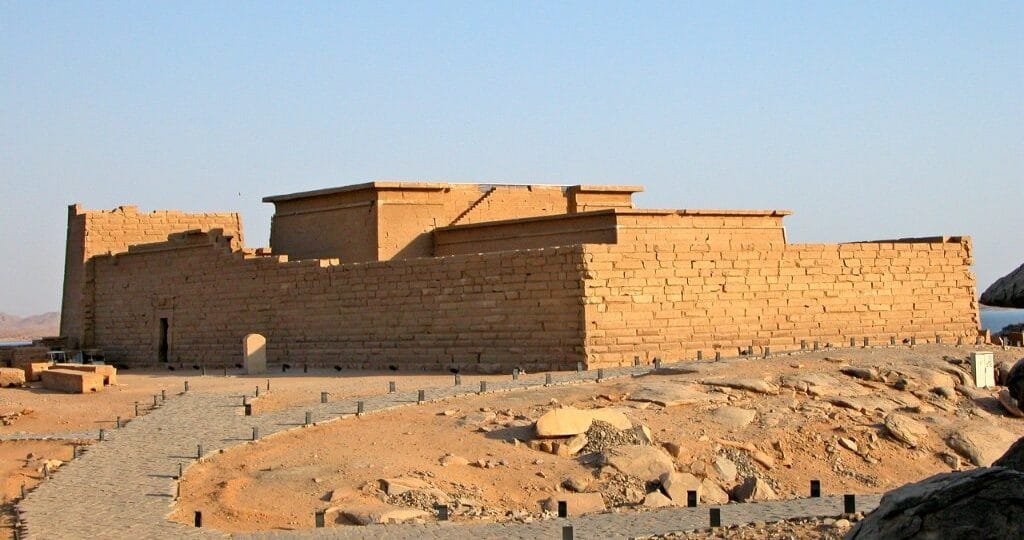
Kalabsha Temple Egypt: The Nubian Sanctuary Aswan’s Crowds Never Found
Why does one of Nubia’s largest temples sit almost empty while Abu Simbel fills with buses at dawn? Kalabsha Temple Egypt survived a flood, an empire, and a continent-spanning rescue effort — and it still feels like a place tourism forgot to find.
What Makes Kalabsha Temple Egypt Different From Every Other Rescued Nubian Monument?
Kalabsha is the largest free-standing temple ever moved out of ancient Nubia. Philae was reassembled on a nearby island shaped to match the original. Abu Simbel was cut from solid rock. Kalabsha was dismantled as a freestanding stone structure and rebuilt from scratch, block by numbered block.
The site layers three civilizations on top of each other:
- An earlier sanctuary honoring Amenhotep II, dated to around 1400 BC
- Ptolemaic additions that expanded the temple’s core
- A Roman-era facade completed under Emperor Augustus, around 30 BC
Mandulis, the god at the center of it all, rarely appears outside Lower Nubia. That alone makes a Kalabsha Temple Egypt visit different from a standard stop at Karnak or Luxor Temple — you are looking at a cult that barely traveled beyond this stretch of the Nile.
The Island With Four Temples Instead of One
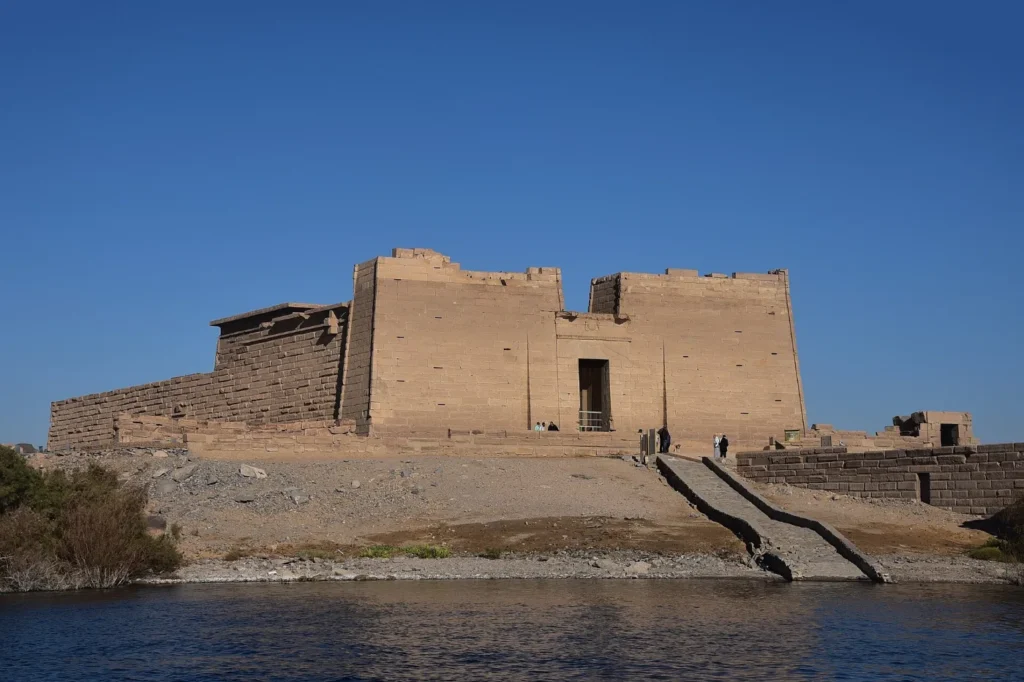
New Kalabsha isn’t a single-monument stop. Egypt’s rescue teams used the same island as a refuge for several structures threatened by the same rising lake.
- Kalabsha Temple itself — the main sanctuary, dedicated to Mandulis
- Beit el-Wali — a smaller rock-cut temple of Ramesses II, with painted reliefs that kept unusually vivid color
- Kiosk of Qertassi — a small Roman pavilion with six columns, often compared to the Kiosk of Trajan at Philae
- Remains of Gerf Hussein — a partially rebuilt Ramesses II temple, the least complete of the group
Walking all four in one visit is something almost no other Aswan stop offers. Curious what else Aswan keeps quiet? Our Aswan tours route past the sites most itineraries skip entirely.
Why Kalabsha Temple Egypt Almost Never Reopened After the Flood
The Aswan High Dam, completed in 1970, meant Lake Nasser would eventually swallow everything below a certain elevation — including Kalabsha’s original home at Bab al-Kalabsha, roughly 50 kilometers south of Aswan.
UNESCO’s International Campaign to Save the Monuments of Nubia coordinated the overall rescue starting in 1960. But Kalabsha’s relocation had its own story: West Germany took direct responsibility for the engineering, sending the construction firm Hochtief to lead the work as a gesture tied to the country’s long history of Egyptological research.
Between 1961 and 1963, engineers dismantled the temple into roughly 13,000 numbered blocks, moved them 15 kilometers north, and reassembled the sanctuary on New Kalabsha Island near the High Dam — years before the reservoir behind it would have reached the original site.
The temple’s survival is now part of a wider UNESCO listing, Nubian Monuments from Abu Simbel to Philae, inscribed in 1979 alongside Philae, Amada, and Abu Simbel itself.
Read the fuller story of what the dam changed, temple by temple, in our Aswan High Dam guide.
The Piece of Kalabsha That Never Came Back to Egypt
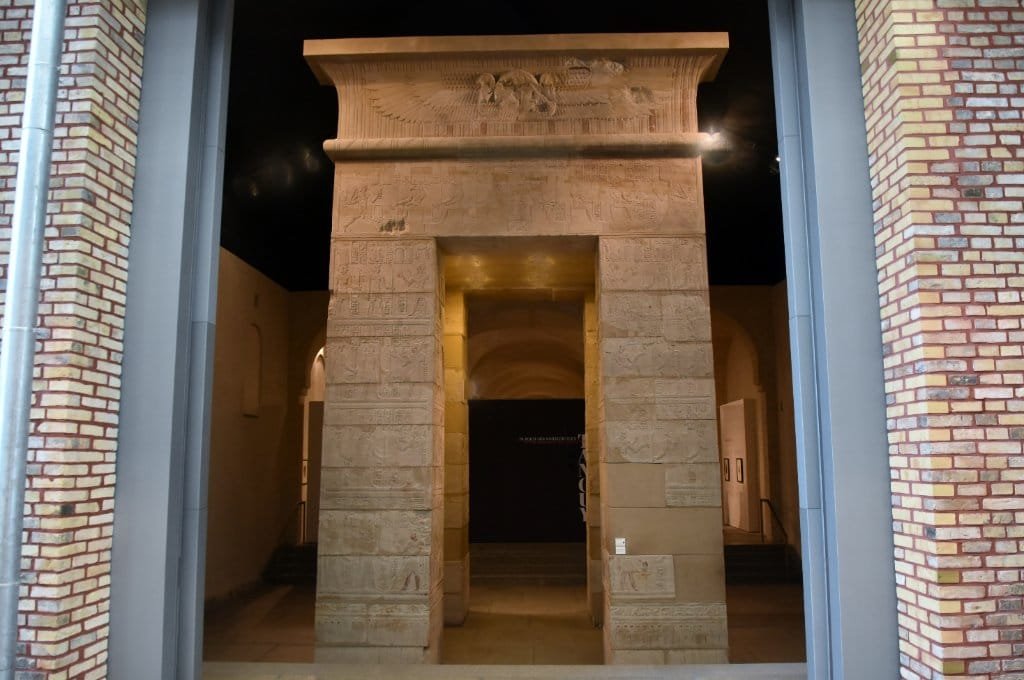
Egypt gifted one of the temple’s original gates to West Germany in 1971, in gratitude for the rescue. That gate never returned. It has stood in Berlin’s Egyptian Museum since the 1970s, reassembled indoors as a freestanding monument travelers can walk through — thousands of kilometers from the sanctuary it once guarded.
It’s a detail most guidebooks skip entirely: part of Kalabsha Temple Egypt is not in Egypt at all. Photographers who have seen both say the two pieces feel like unfinished sentences — the temple in Aswan, the doorway in Berlin.
A Guide’s Take on the Temple Almost No One Visits
“Most of my guests have never heard of Kalabsha before I mention it,” says Youssef, a Nile Travel Machine guide who has led Aswan itineraries for over a decade. “I tell them: you’ll get Philae’s atmosphere without Philae’s crowd. Bring water and good shoes — there’s no shade once you’re past the boat dock, and the light off the lake gets sharp by mid-morning.”
His practical tip: request Kalabsha early in the day, right after the High Dam viewpoint, before the heat sets in and before other boats start crossing.
Kalabsha Temple Egypt at a Glance
| Dedicated to | Mandulis, Nubian sun god, with Isis and Osiris |
| Built | Shrine of Amenhotep II (~1400 BC), expanded under the Ptolemies and Augustus (~30 BC) |
| Original site | Bab al-Kalabsha, about 50 km south of Aswan |
| Current site | New Kalabsha Island, near the Aswan High Dam |
| Relocated | 1961–1963, in roughly 13,000 numbered blocks |
| Rescue led by | West Germany’s Hochtief, within the UNESCO Nubia campaign |
| Heritage status | UNESCO’s Nubian Monuments from Abu Simbel to Philae, listed 1979 |
| Companion sites | Beit el-Wali, Kiosk of Qertassi, remains of Gerf Hussein |
Getting to New Kalabsha: Why Most Travelers Book Instead of Going Alone
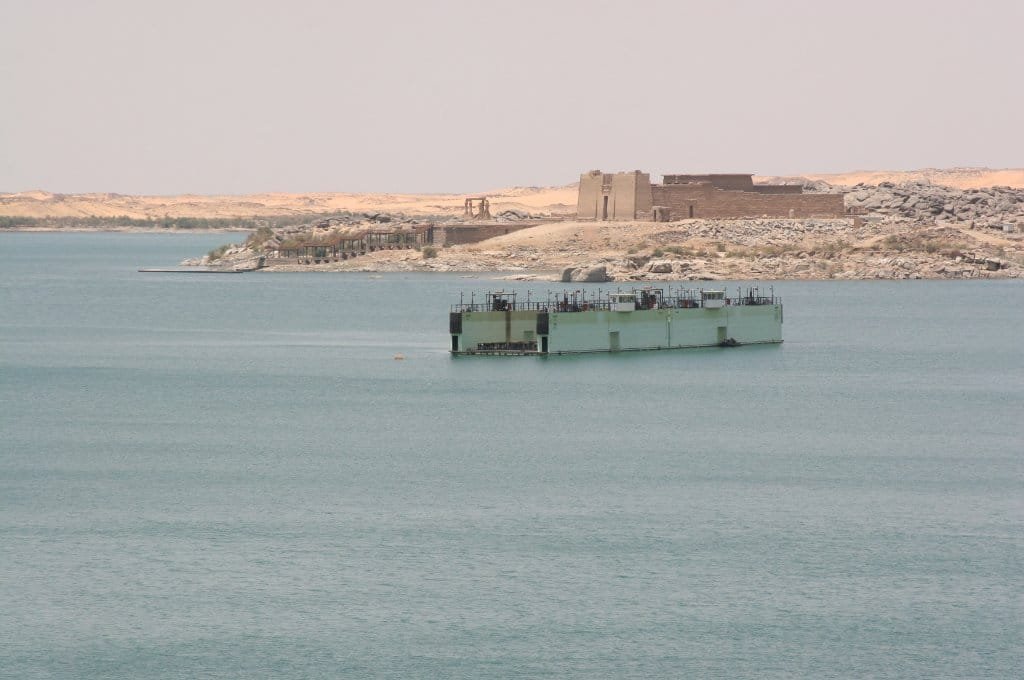
New Kalabsha sits just past the High Dam’s security zone, which makes independent access genuinely complicated. Reaching it on your own typically means a local microbus to the dam, a checkpoint crossing with your passport, and then negotiating a small boat across the water — with no guarantee a ticket seller will even be on duty.
A guided visit removes all of that. Transport, checkpoint clearance, and the boat crossing are arranged before you arrive, and a licensed Egyptologist means the reliefs of Mandulis, Augustus, and Amenhotep II actually mean something instead of blending into another wall of carvings.
Ready to see the temple Germany helped save, without the checkpoint negotiations? Book our Kalabsha Temple day tour from Aswan and let a local guide handle the logistics.
Related Aswan Temples Worth Pairing With Kalabsha
Kalabsha rewards travelers who already have an Aswan base. It pairs naturally with:
- The Philae Temple tour, for a second — very different — rescued-temple story on the same afternoon
- Our guide to what else to see in Aswan, for Nubian villages and the wider city beyond the temples
Travelers combining Aswan with the rest of Egypt often continue north to Luxor’s temples and tombs, add Cairo’s pyramids to the itinerary, or unwind afterward on Hurghada’s Red Sea coast. Pairing Kalabsha with Philae and the High Dam makes a full, unhurried Aswan day — ask us to build that exact route for you.
FAQs About Kalabsha Temple Egypt
Why is Kalabsha Temple dedicated to Mandulis instead of a better-known Egyptian god?
Mandulis was Lower Nubia’s own sun god, worshipped specifically along this stretch of the Nile rather than across all of Egypt. Kalabsha Temple Egypt is one of the clearest surviving examples of that regional Nubian cult, distinct from the pantheon seen at Karnak or Luxor.
What happened to the temple’s original gateway?
Egypt presented one of Kalabsha’s gates to West Germany in 1971 as thanks for the rescue effort. It has been reassembled and displayed in Berlin’s Egyptian Museum ever since, making it one of the only major Nubian temple elements on permanent display outside Egypt.
How many ancient temples share the island with Kalabsha?
Four, including Kalabsha itself. Beit el-Wali, the Kiosk of Qertassi, and the partially reconstructed remains of Gerf Hussein were all relocated to the same site during the same rescue campaign.
Why does Kalabsha Temple Egypt get so few visitors compared to Abu Simbel or Philae?
Access requires crossing the High Dam’s security zone and a short boat ride, which discourages casual, unplanned stops. Most travelers only reach it as part of an organized Aswan tour, which keeps visitor numbers low even in peak season.
Conclusion
Kalabsha Temple Egypt packs three civilizations, a cross-border rescue story, and a companion cluster of Nubian monuments into one quiet island near the High Dam — with barely another traveler in sight. Ready to have a UNESCO-listed temple almost to yourself? Book your Kalabsha Temple day tour with Nile Travel Machine.
About the author: This guide was reviewed by the Nile Travel Machine Aswan team, drawing on years of on-the-ground experience guiding travelers through Nubia’s relocated monuments.