

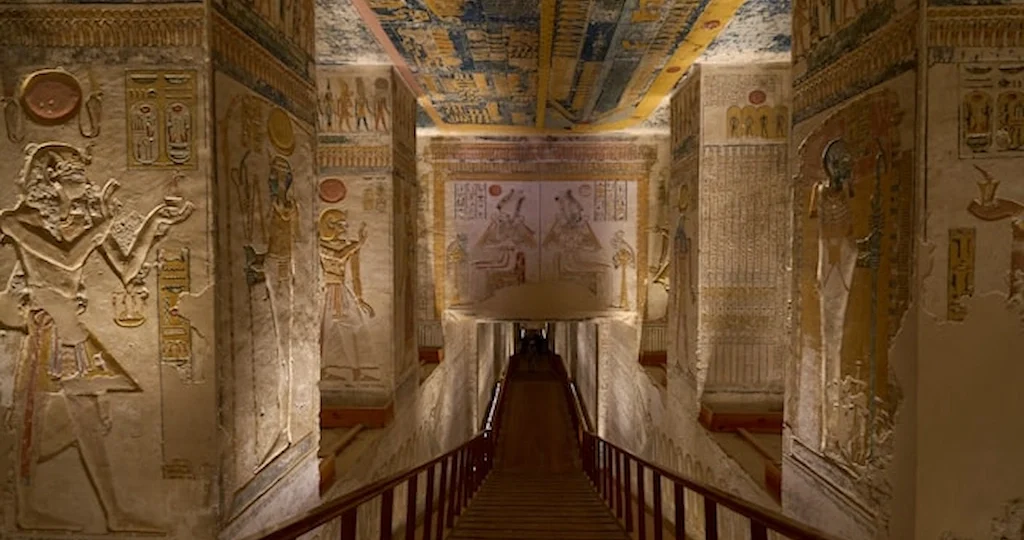
Tomb of Ramses V & VI: The Accident That Saved King Tut
Which pharaoh is actually buried in the tomb of Ramses V & VI? The answer surprises most first-time visitors to Luxor’s Valley of the Kings, and it starts with a nephew who quietly took over his uncle’s unfinished grave.
Why Does the Tomb of Ramses V & VI Have Two Pharaohs’ Names?
Ramses V began carving this tomb around 1147 BC, but he died before it was finished. His uncle, Ramses VI, inherited the throne within a year and reused the unfinished tunnel as his own, enlarging it into one of the longest tombs in the entire valley. Egyptologists still debate whether Ramses V’s body was ever actually placed here before his uncle claimed the space for himself.
Inside KV9: Quick Facts Before You Go
A few numbers help frame what you’re about to walk through.
| Fact | Detail |
|---|---|
| Tomb number | KV9 |
| Location | Valley of the Kings, Luxor’s West Bank |
| Built by | Ramses V, enlarged and finished by Ramses VI |
| Dynasty | Twentieth Dynasty, roughly 1147 to 1137 BC |
| Length | About 116 meters on a single straight axis |
| Neighbor | A few meters from Tutankhamun’s tomb, KV62 |
Ready to walk where two pharaohs once rested? Our Luxor tours include the Valley of the Kings on the standard sightseeing route.
The Accident That Saved Tutankhamun’s Tomb for 3,000 Years
While cutting KV9’s corridors, ancient workmen dumped debris and built their site huts directly over a stairway just a few meters away, without knowing what lay beneath. That stairway led to Tutankhamun’s tomb.
The rubble buried the entrance so completely that grave robbers who plundered almost every other tomb in the valley never found it. When Howard Carter finally cleared the site in 1922, an earlier pharaoh’s construction mess turned out to be the reason he found the only nearly intact royal burial ever recovered in Egypt.
What Do the Ceiling and Walls Actually Show?
The burial chamber ceiling is the single reason most Egyptologists rank KV9 among the finest tombs in the valley.
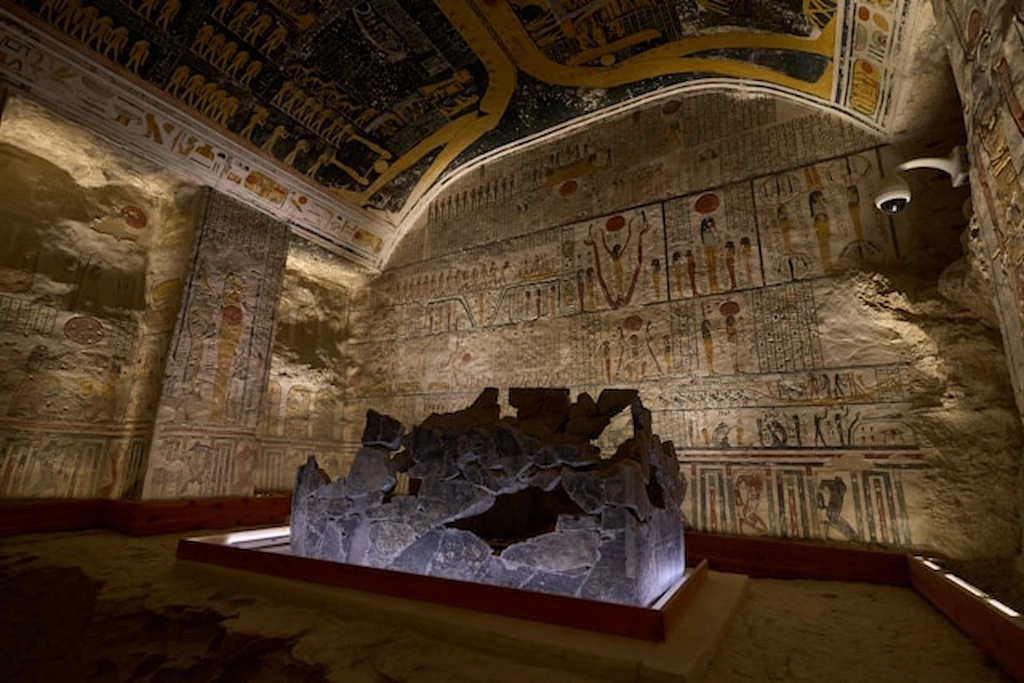
- Two full-length images of the sky goddess Nut stretch across the ceiling, swallowing the sun at dusk and giving birth to it at dawn.
- The Book of the Day and the Book of the Night frame her body with star charts and the hours of the night sky.
- Star clocks track twelve decans, a timekeeping system found in only a handful of royal tombs.
- Corridor walls carry the Book of Gates and the Book of Caverns, guiding the king through the underworld.
- The burial chamber itself is wrapped in the Book of the Earth, surrounding a broken stone sarcophagus.
Want to see that ceiling before its colors fade further? Explore our Cairo and Luxor tours and add the Valley of the Kings to your route.
Proof Ancient Visitors Already Loved This Tomb
Long before modern tourism, KV9 already had a following. Greek, Latin, and Coptic graffiti covers its walls, left by ancient travelers, monks, and Roman-era visitors who wandered in centuries after the pharaohs were sealed inside.
That graffiti is how historians know the tomb stood open, and admired, since antiquity, unlike many royal tombs that stayed sealed until the last two centuries.
A Guide’s Take: The Detail Most Tour Groups Rush Past
“Everyone photographs the starry ceiling and walks straight past the side chamber reliefs,” says Mostafa, a Nile Travel Machine Egyptologist guide who has led groups through the Valley of the Kings for over a decade.
“Look at the unfinished sections near the burial chamber. You can see the different carving stages stacked on top of each other, sketch lines, unfinished plaster, then the final painted layer. It’s the clearest lesson anywhere in the valley on how these tombs were actually built.”
Where Does the Mummy of Ramses VI Rest Today?
Ramses VI’s mummy never stayed inside KV9. Ancient priests moved it for safekeeping during a wave of tomb robberies, and it resurfaced in 1898 inside a crowded royal cache found in the nearby tomb of Amenhotep II.
Today it rests in the Egyptian Museum in Cairo, a short flight from the empty, broken sarcophagus still sitting inside KV9.
How Do You Actually Get Inside KV9?
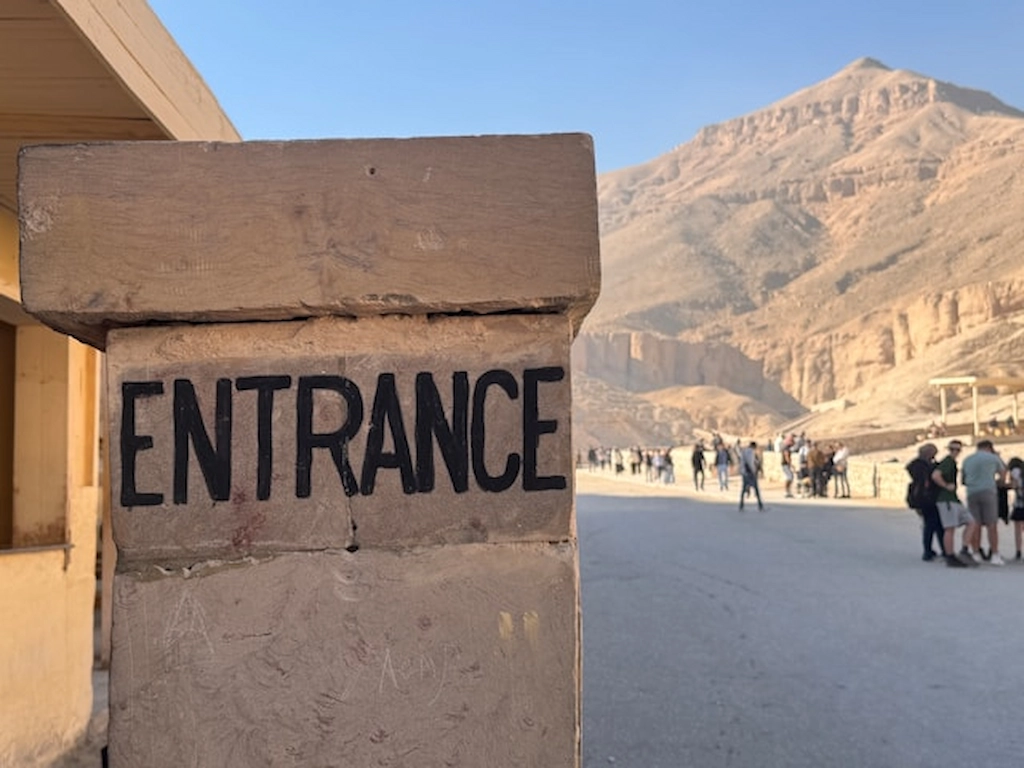
The tomb of Ramses V & VI comes included on the standard Valley of the Kings ticket, one of three tombs you can enter without paying extra.
- Morning visits beat the afternoon heat and the tour bus crowds.
- The floor stays flat and wide for most of the tomb’s length, so it suits travelers who skip steeper tombs nearby.
- Phone photography is allowed inside without an extra permit, unlike a handful of other royal tombs in the valley.
Not sure how to fit it into a wider itinerary? Our Luxor day tours already build the Valley of the Kings around your pace.
Tomb of Ramses V & VI: Quick Answers
Who is buried in KV9, Ramses V or Ramses VI?
Ramses VI is the tomb’s final and best-documented occupant. Ramses V began building it, but it’s unclear whether his body was ever placed here before his uncle claimed it.
Why does the ceiling show the goddess Nut twice?
The two images represent day and night. One shows Nut swallowing the sun at sunset, the other shows her giving birth to it at sunrise, framing the tomb’s astronomical ceiling.
Did ancient visitors really leave graffiti inside the tomb?
Yes. Greek, Latin, and Coptic graffiti dating back roughly 2,000 years still covers parts of the walls, proving the tomb of Ramses V & VI stood open long before modern tourism began.
How close is this tomb to Tutankhamun’s tomb?
KV9 sits only a few meters from Tutankhamun’s tomb entrance. Debris and worker huts from its construction accidentally buried and protected KV62 for around 3,000 years.
One Tomb, Two Kings, One Accidental Miracle
The tomb of Ramses V & VI is more than a starlit ceiling in the Valley of the Kings. It’s a burial two pharaohs shared, a graffiti wall ancient tourists left behind, and the accidental reason Tutankhamun’s treasures survived untouched.
For a deeper academic record of the site, the Egyptian Ministry of Tourism and Antiquities keeps an official page on the tomb.
Travelers pairing Luxor with the rest of the Nile often continue on to Aswan or extend the trip with a few coastal days through our Hurghada tours. Ready to see it for yourself? Book your Luxor Valley of the Kings tour with Nile Travel Machine.
