

Temple of Edfu Egypt: The Complete Visitor Guide to Horus’s Sanctuary
What if one of Egypt’s most awe-inspiring temples was almost completely buried — and only rediscovered 170 years ago? The Temple of Edfu Egypt is precisely that: a colossal Ptolemaic marvel hiding in plain sight along the Nile, waiting to stop every visitor dead in their tracks.
If you’re planning a Nile cruise between Luxor and Aswan, a Temple Edfu excursion isn’t just recommended — it’s non-negotiable. Here’s everything you need to know before you visit.
What Makes the Temple of Edfu Different From Every Other Site in Egypt?
The Temple of Horus at Edfu is the best-preserved ancient temple in Egypt — and it’s not even close. While Karnak stuns with sheer scale and Abu Simbel dazzles with drama, Edfu wins on completeness. Every hall, corridor, sanctuary, and inscription has survived almost entirely intact.
Built between 237 and 57 BC during the Ptolemaic era, the temple’s construction spanned nearly 180 years. Yet its foundations honour a site sacred since the time of Pharaoh Thutmose III in the New Kingdom, making its spiritual roots far older than its stone walls suggest.
- Location: West bank of the Nile, Edfu city, Aswan Governorate
- Dedicated to: Horus, the falcon-headed god of kingship
- Construction period: 237–57 BC (Ptolemaic)
- Size: Second-largest temple in Egypt after Karnak
- UNESCO World Heritage Site: Part of the Ancient Thebes listing
The Relief That Stumped Egyptologists for Decades
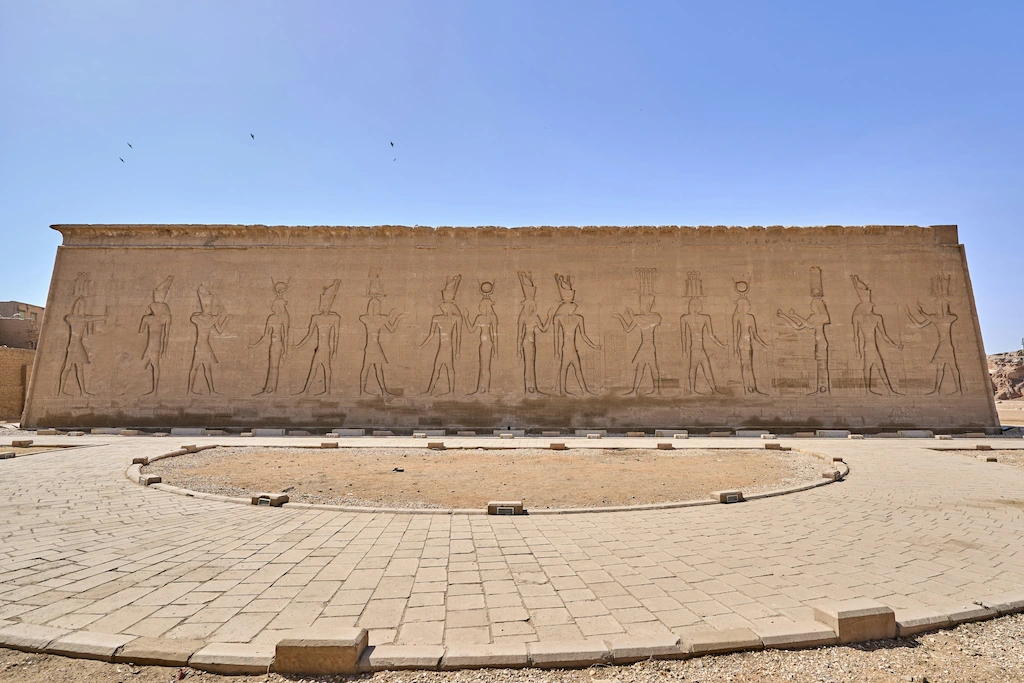
Along the inner enclosure wall of Edfu runs a series of mythological battle reliefs depicting the cosmic war between Horus and Set — but one sequence puzzled scholars for generations.
In it, Horus and his falcon army are shown using what appear to be harpoon-like weapons from boats, a scene that doesn’t align neatly with any known written myth.
Egyptologist Émile Chassinat, who spent over 40 years documenting Edfu’s inscriptions in the early 20th century, argued these images preserved an archaic ritual drama — a sacred play performed annually at the temple.
Later scholars debated whether this was a literal re-enactment of a predynastic conflict or a purely symbolic cosmic narrative. The debate is still alive in academic circles today. (Read the scholarly discussion on JSTOR)
It’s the kind of detail no other temple in Egypt offers so richly — and one most tour guides skip entirely.
Expert Insight: “Visitors always gravitate toward the massive pylon,” says Mohamed Fathy, a licensed Egyptologist guide based in Luxor with 18 years of experience. “But I always take them to the inner Naos first — the granite shrine where the golden statue of Horus once stood. That’s where the real silence hits you.”
The Architecture: A Guided Walk Through the Temple Edfu
A Temple Edfu tour moves through a deliberate sequence of spaces, each progressively more sacred. Understanding this sequence transforms a visit from a photo opportunity into a genuine encounter with ancient Egyptian cosmology.
The Pylon — Where the Earth Meets the Sky
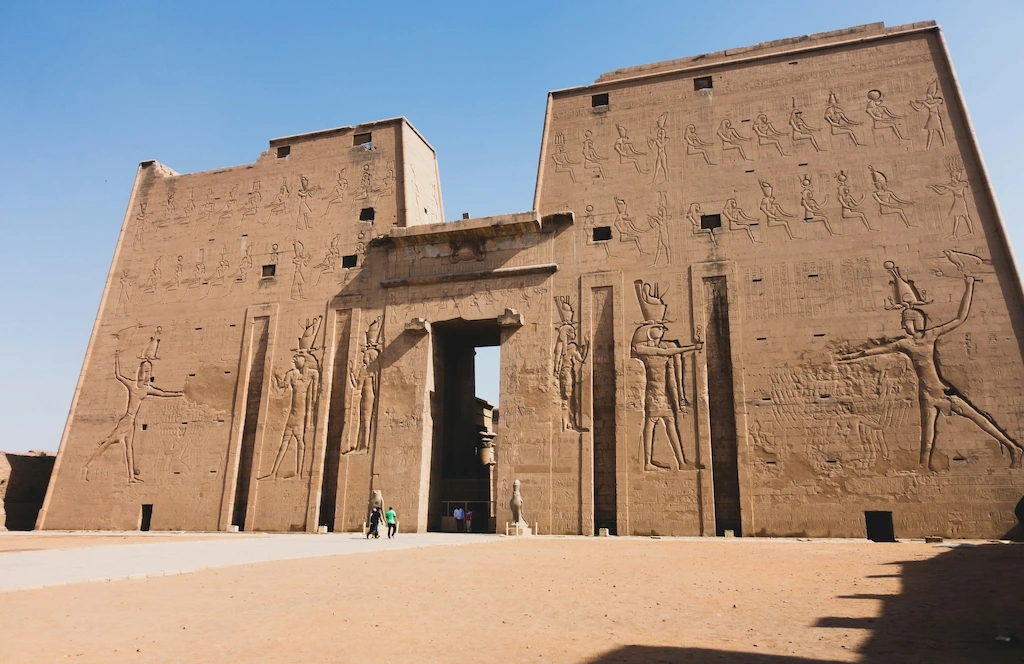
At 36 metres tall, the entrance pylon is one of the tallest in Egypt. Its outer faces show Ptolemy XII smiting enemies before Horus — a political statement as much as a religious one, legitimising Greek rulers as true pharaohs. Look for the four flag-mast grooves cut into the pylon’s face; the poles that once stood here would have been visible for miles across the floodplain.
The Forecourt & Hypostyle Halls
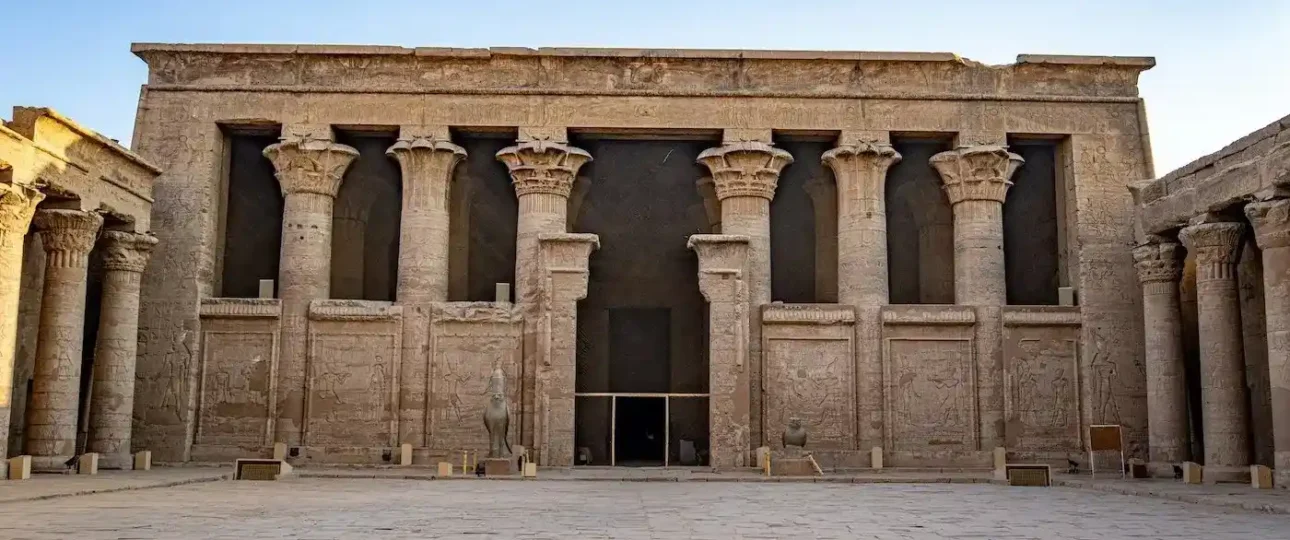
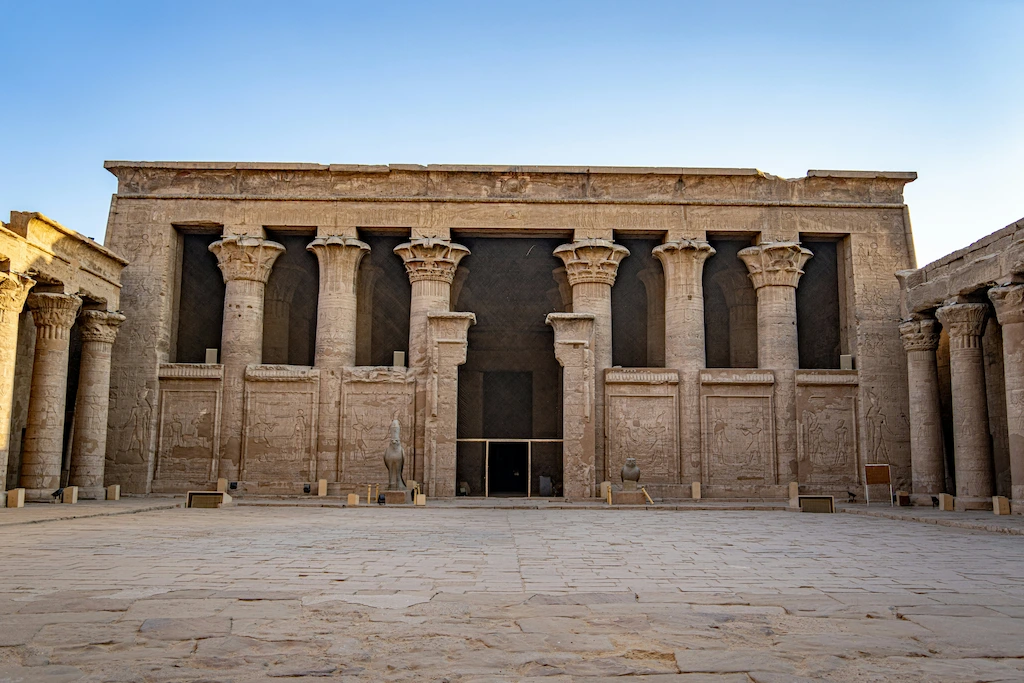
The open forecourt leads into the Great Hypostyle Hall, supported by 12 columns with elaborate floral capitals. A second, smaller hypostyle hall follows — each hall marking a transition from the public to the increasingly restricted sacred interior. Lighting changes as you move deeper; the ancients designed this intentionally.
The Sanctuary of Horus
At the temple’s heart sits the granite Naos — the innermost shrine — dating from the reign of Nectanebo I (380–362 BC), predating the Ptolemaic structure around it.
A replica of Horus’s sacred barque rests nearby, used to carry the god’s statue during festivals. This is the quietest and most powerful space in the entire complex.
Ready to experience this with an expert guide? Browse our Aswan day tours that include a dedicated Temple Edfu visit with a licensed Egyptologist.
The Feast of the Beautiful Meeting: Edfu’s Most Sacred Ritual
Once a year, the statue of Hathor — goddess of love and beauty — was transported by sacred barque from her temple at Dendera, sailing upriver to Edfu.
The “Feast of the Beautiful Meeting” celebrated the divine union of Horus and Hathor, drawing pilgrims from across Egypt to witness the ceremony.
The walls of Edfu record this event in extraordinary detail: the procession, the offerings, the music, the jubilation. It’s one of the most thoroughly documented religious festivals from the ancient world, and Edfu is where you read its full script in stone.
Practical Guide: How to Visit the Temple of Edfu Egypt
Planning a Temple Edfu one day excursion is straightforward, but a few insider tips make the difference between a rushed stop and a truly memorable visit.
| Detail | Information |
|---|---|
| Opening Hours | Daily, 07:00 – 17:00 (winter) / 06:00 – 18:00 (summer) |
| Entrance Fee | From EGP 450 (adult) / EGP 225 (student) — subject to change |
| Best Time to Visit | Early morning (7–9 AM) before cruise groups arrive |
| Time Needed | 90–120 minutes with a guide; 45–60 minutes independently |
| Getting There | By Nile cruise (most common), private car from Luxor (2 hrs) or Aswan (1.5 hrs) |
| Dress Code | Shoulders and knees covered; comfortable closed shoes strongly advised |
| Photography | Permitted throughout (no flash in inner chambers) |
Pro tip: If you’re visiting on a Nile cruise, ask your cruise director to schedule Edfu first thing in the morning. Most ships dock overnight — guests who visit at 7 AM have the pylon virtually to themselves.
Exploring the Upper Nile region? Our Luxor day tours are designed to combine Edfu seamlessly with Kom Ombo, Karnak, and the Valley of the Kings — maximising your time without the rush.
Coming from Luxor by road or river? You will usually pass Esna first. Its sunken hall of painted columns is a quiet warm-up for Edfu, and our guide to the Esna temple Egypt shows what to look for.
Edfu Temple Tips: What Most Visitors Miss
- The Nilometer well: Inside the complex, a small shaft was used to measure annual flood levels — easy to miss but fascinating.
- The birth house (Mammisi): Located in the forecourt, this smaller chapel depicts the birth and childhood of Horus, with some of the temple’s most intimate and detailed reliefs.
- The rooftop: Not always open, but when accessible, offers a commanding view of the Nile floodplain and the town of Edfu below.
- The temple library inscriptions: A rectangular room off the first hypostyle hall lists the sacred texts once stored there — one of antiquity’s earliest recorded library catalogues.
Frequently Asked Questions About the Temple of Horus at Edfu
Why was Edfu built during the Greek period, but looks so Egyptian?
The Ptolemaic rulers understood that political legitimacy in Egypt required religious conformity. They hired Egyptian priests as architects and decorators, resulting in a temple that is iconographically indistinguishable from earlier pharaonic work — despite being built by Greeks. This deliberate cultural adoption is one of the most fascinating chapters in Egyptian history.
What language are the inscriptions at the Temple of Edfu written in?
The inscriptions are in hieroglyphic Egyptian, including some of the most detailed ritual texts from the ancient world. Edfu’s walls contain the complete liturgy for daily temple rituals — essentially a full operating manual for running a divine household. The academic study of these texts continues to yield new findings today.
Is the Temple of Edfu Egypt accessible for visitors with limited mobility?
The main forecourt and first hypostyle hall are accessible via flat stone paving. The inner sanctuary involves narrow corridors and some steps. We recommend raising this with your tour operator in advance so arrangements can be made for the best possible experience.
How does visiting Edfu fit into a broader Egypt itinerary?
Edfu sits naturally between Luxor (2 hours north) and Aswan (1.5 hours south), making it a perfect mid-point on any Nile cruise or upper Egypt road trip. Combine it with Kom Ombo (30 minutes south of Edfu) for a powerful double-temple day. Our Nile cruise packages include both as standard highlights.
Conclusion
The Temple of Horus at Edfu is not simply a well-preserved ruin — it is a complete, readable document of one of history’s most sophisticated civilisations, written in stone and still open for interpretation. Few sites anywhere on earth offer this combination of scale, condition, and depth.
Whether you’re a first-time visitor to Egypt or returning for the third time, Edfu rewards every level of curiosity. Explore our Nile cruise and Upper Egypt tour options to plan your visit to Edfu alongside Egypt’s greatest monuments.
