

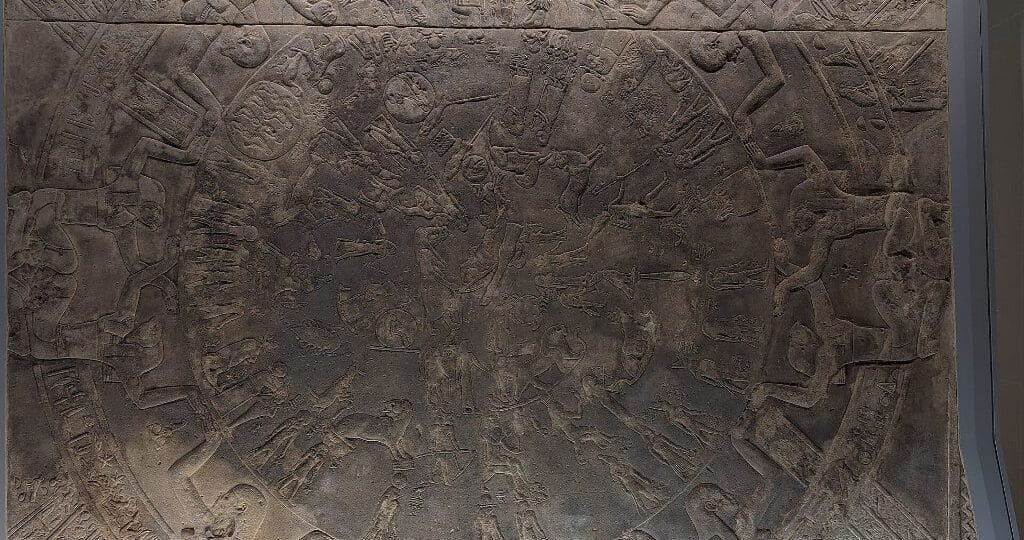
Dendera Zodiac: The Egyptian Sky Map That Sailed to Paris
Why does Egypt’s most famous ceiling hang in Paris instead of the temple it was carved for? The Dendera zodiac — the only complete circular sky map to survive from ancient Egypt — has a stranger travel story than most of the people who visit it. Here is what it shows, how it left, and where you can stand under it today.
What Is the Dendera Zodiac?
The Dendera zodiac is a carved sandstone ceiling from the Temple of Hathor at Dendera, near modern Qena, showing the night sky as a great disc held aloft by goddesses and falcon-headed spirits. Scholars date this ancient Egyptian Dendera zodiac to the Ptolemaic era, around the first century BC — the only complete circular star map left from the ancient world’s longest civilization.
- Carved for a rooftop chapel of Osiris above the main temple halls.
- Blends the 12 zodiac signs you know with Egypt’s own 36 star-groups, the decans.
- The original hangs in the Louvre in Paris; a faithful replica now fills its place in the temple ceiling.
One ceiling, two homes — and both are worth standing under.
1821: The Year a Temple Ceiling Sailed to Paris
In 1821, a French expedition — financed by antiquarian Sébastien Saulnier and carried out by engineer Claude Lelorrain — cut the zodiac out of the chapel roof with saws and gunpowder, lowered the blocks down the temple walls, and floated them up the Nile toward the sea.
The slab was shipped to France, purchased for the royal collection, and eventually installed in the Louvre, where it remains one of the stars of the museum’s Egyptian galleries.
It is one of the most debated removals in the history of Egyptology, and Egyptian voices have long called for the ceiling’s return. What greets you at Dendera today is a precise replica set into the original chapel — with the saw lines of 1821 still visible around it.
What Can You Actually See on the Sky Map?
More than you might expect — the disc reads like a compressed atlas of two astronomies sharing one sky. Stand under it (in Paris or at Dendera) and look for these:
- Taurus the bull and Scorpio the scorpion, carved almost exactly as you picture them.
- The 36 Egyptian decans marching around the rim — the star-groups that timed Egypt’s calendar long before the zodiac arrived.
- The five planets known to antiquity, scattered among the constellations.
- Four standing goddesses and pairs of falcon-headed figures holding the entire heavens up at the corners.
That mixture — Greek signs resting on an older Egyptian sky — is the ceiling’s quiet message: by Cleopatra’s century, Egypt was reading the stars in two languages at once.
Paris or Dendera: Where Should You See It?
| Where | What You’ll Find |
|---|---|
| Louvre, Paris | The original sandstone ceiling, displayed at eye level so you can study every figure up close. |
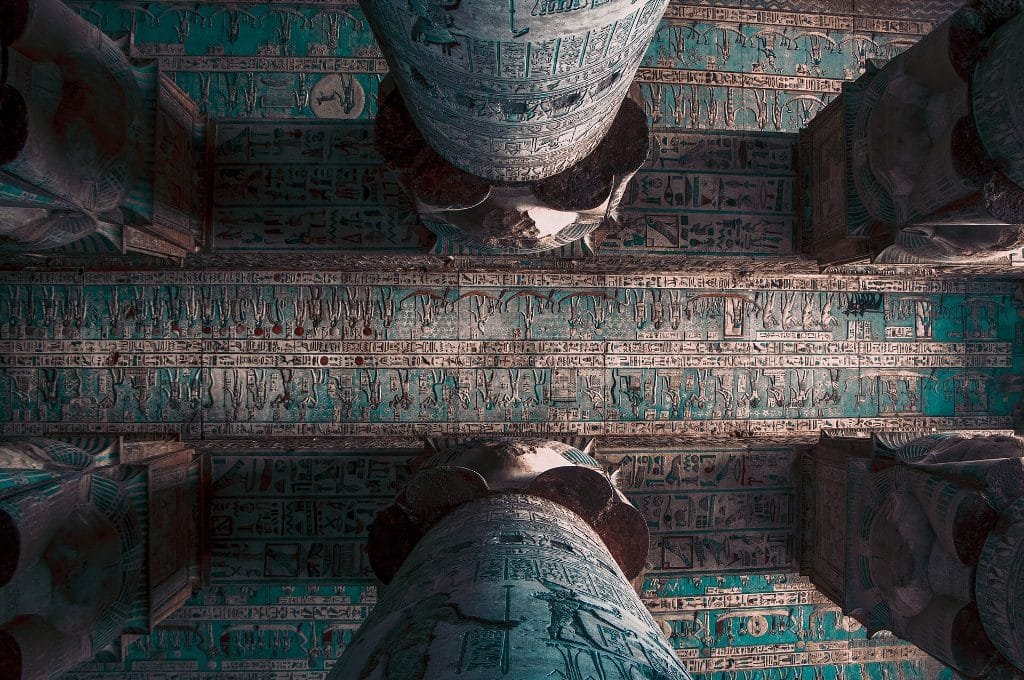
| Dendera Temple, Egypt | The full-scale replica in its true position overhead, plus the temple’s famous painted ceilings, crypts and rooftop chapels around it. |
| The honest advice | See Dendera first. The replica in its real chapel, inside a working temple of Hathor, gives the ceiling its meaning — the Louvre gives it detail. |
Visiting the Zodiac Chapel on a Nile Journey
Dendera is an easy morning from Luxor, and the zodiac chapel is the highlight of the temple’s upper level — when the roof is open, it is one of the few temple rooftops in Egypt you can actually walk. Go early: the halls are cool, the painted ceilings glow, and the crowds are still at breakfast.
Our Dendera Temple tour from Luxor builds the day around exactly that window, and our full Dendera Temple complex guide covers the crypts and halls beyond the zodiac.
Once you are up on the roof, the temple has more to tell. Our guide to the Temple of Hathor Dendera follows the New Year sunrise ritual that carried the goddess up those stairs, plus the Cleopatra relief and the birth houses.
Sailing rather than driving? Some slow itineraries reach Dendera by river — reading our dahabiyah vs Nile cruise comparison will tell you which boat suits that pace, and the best Nile river cruises pair Dendera with the classic Luxor–Aswan run.
Want the zodiac without the logistics? Tell us your dates and we’ll slot Dendera into your Luxor mornings.
Looking for another sky ceiling? Esna still has one in place, with moon phases, wind gods and zodiac signs. See our Esna temple guide for the details.
FAQs About the Dendera Zodiac
How old is the Dendera zodiac?
Scholarly consensus places it in the Ptolemaic era, around the first century BC, based on the positions of the planets carved into the design. Claims of a far older date circulated in the 19th century but did not survive the evidence.
Why is the original Dendera zodiac in Paris?
Because a French expedition removed it from the temple roof in 1821 and shipped it to France, where it entered the royal collection and later the Louvre. Egyptian officials and Egyptologists have repeatedly called for its return.
Can you climb to the zodiac chapel at Dendera today?
When the temple roof is open to visitors, yes — the rooftop chapel holds the replica in its original position, and reaching it up the temple’s ancient staircase is half the experience.
Is the Dendera zodiac astronomy or astrology?
Both, by design. It is a genuine map of the visible sky and a religious calendar for temple ritual — a working document of how Egypt watched the heavens, not a horoscope wheel.
Final Thoughts
The Dendera zodiac is really two journeys: a ceiling that traveled to Paris, and a traveler — you — coming the other way to stand where it belongs. See the replica in its chapel, read the sky in two languages, and let the temple do the rest. When you’re ready to plan the morning, our Luxor day tours make Dendera the easiest wonder you’ll ever reach.
