

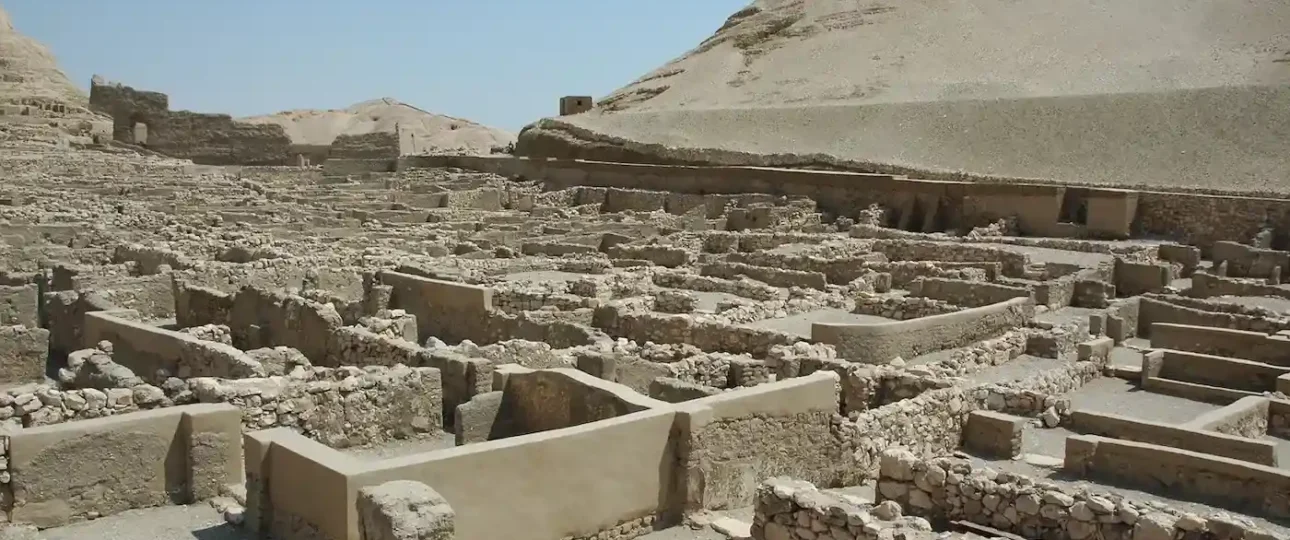
Deir el-Medina Excursion: The Village That Built the Valley of the Kings
What if the greatest untold story of ancient Egypt isn’t inside a pharaoh’s tomb — but in the village that built it? A Deir el-Medina excursion takes you to the West Bank of Luxor, where the real architects of eternity lived, argued, went on strike, and left behind a paper trail that still baffles historians today.
The Strike That Stopped the Pharaoh’s Tomb
In the 29th year of Ramesses III’s reign, the artisans of Deir el-Medina did something no one in the ancient world had ever done before: they walked off the job. Their rations of grain, oil, and fish hadn’t arrived for weeks. So they sat down outside the royal mortuary temples and refused to work.
We know this because they wrote about it. The Turin Strike Papyrus — one of the most extraordinary documents to survive from ancient Egypt — records their grievances in vivid detail. “We are hungry,” they said, “and we have come here driven by hunger and thirst. There is no clothing, no ointment, no fish, no vegetables.”
This wasn’t a mob. It was an organized, literate, self-aware workforce — and their village at Deir el-Medina is the only place in ancient Egypt where we can read their daily lives in their own words.
Ready to walk the streets of Egypt’s most remarkable ancient village? Explore our curated Luxor Day Tours and add Deir el-Medina to your itinerary.
Who Were the People of Deir el-Medina?
The village — known in ancient times as Set Maat, “Place of Truth” — was founded during the reign of Thutmose I (around 1500 BCE) and remained inhabited until the end of the Twentieth Dynasty. For nearly 450 years, a closed community of elite craftsmen lived here, completely cut off from the outside world.
These weren’t ordinary laborers. They were:
- Draughtsmen — skilled artists who traced the outlines of tomb paintings
- Sculptors — who carved the intricate reliefs in the Valley of the Kings
- Painters — who applied the vivid pigments that still glow today
- Scribes — who documented everything from legal disputes to love poetry
- Foremen — who led two gangs (Left and Right) into the royal tombs each shift
Access to the village was restricted. A team of policemen — the Medjay — patrolled the surrounding desert. The secrecy wasn’t just bureaucratic; it protected the locations of royal burials from tomb robbers. Ironically, several Deir el-Medina workers were later prosecuted for robbing the very tombs they had built.
What Does a Visit to Deir el-Medina Actually Look Like?
A visit to Deir el-Medina on Luxor’s West Bank rewards the intellectually curious traveler. Unlike the Valley of the Kings — which draws enormous crowds — Deir el-Medina remains remarkably quiet and intimate, making it one of the most rewarding stops on any Deir el-Medina Egypt tour.
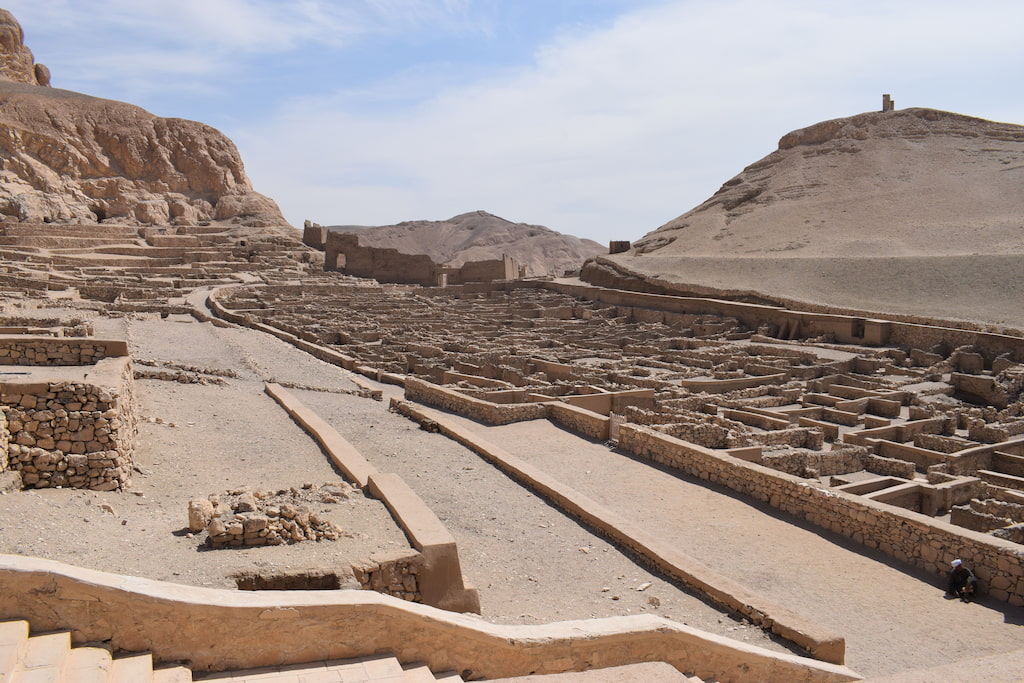
The Workers’ Village
The excavated remains of around 70 houses line two narrow streets. Each house follows the same plan: an entrance hall, a main living room with a low brick bench, a bedroom, a cellar, and a small rear courtyard with a staircase to the roof. Walking through them, you immediately sense the scale of family life — cramped, communal, and surprisingly modern in its organization.
The Ptolemaic Temple of Hathor
At the northern end of the site stands a well-preserved temple dedicated to Hathor, goddess of joy, love, and beauty — and the patron deity of craftsmen. Built during the Ptolemaic Period but incorporating earlier shrines, the temple’s colorful reliefs are in exceptional condition. The birthing chapel inside is particularly striking, decorated with scenes rarely found elsewhere in Egypt.
The Decorated Tombs
The tombs the artisans built for themselves are among the finest in Egypt — small in scale but staggering in quality. The tomb of Sennedjem (TT1) is the most celebrated: its burial chamber features flawless paintings of Sennedjem and his wife working in the Fields of Iaru, the Egyptian afterlife paradise. The colors — ochre, turquoise, white, black — look as fresh as the day they were painted, roughly 3,300 years ago.
Other tombs worth visiting include those of Inherkhau (TT359), famous for a rare image of a human-headed serpent, and Pashedu (TT3), which shows the deceased kneeling beneath a palm tree beside a pool of water.
Expert Insight: “Most visitors spend 20 minutes here and leave without understanding what they’ve seen,” says Mohammed Hassan, a licensed Egyptologist guide based in Luxor with over 15 years of experience. “I always tell people: give this place 90 minutes. Sit inside Sennedjem’s tomb. Read the ostraca. This is where ancient Egypt becomes human.”
Planning a trip to Deir el-Medina as part of a longer journey? Browse our Nile Cruise packages — several itineraries stop at the West Bank and can be extended to include Deir el-Medina.
The Ostraca: When Ancient Egyptians Doodled on Stone
One of the most extraordinary aspects of a Deir el-Medina tour is the sheer volume of written material the village produced. On limestone chips and pottery shards — called ostraca — the workers left behind shopping lists, medical prescriptions, legal complaints, erotic sketches, fairy tales, hymns to the sun, and even what appears to be the world’s oldest worker’s attendance sheet.
The Deir el-Medina ostraca are now scattered across museums worldwide: the Egyptian Museum in Cairo, the British Museum, and the Rijksmuseum van Oudheden in Leiden. But the context — the village itself — only exists in Luxor.
Practical Planning: Your Deir el-Medina Tour at a Glance
| Detail | Information |
|---|---|
| Location | West Bank of Luxor, approx. 2 km south of the Valley of the Queens |
| Best Time to Visit | October to April (cooler temperatures); arrive before 9 AM to beat the heat and crowds |
| Recommended Duration | 60 to 90 minutes on-site |
| Combined With | Valley of the Kings, Valley of the Queens, Temple of Hatshepsut (all within 5 km) |
| Entry Tickets | Separate tickets required for the temple, the village, and each tomb |
| Getting There | By private car, taxi, or organized West Bank day tour from Luxor |
| Photography | Camera fees apply inside the tombs |
The One Relief That Rewrote Egyptologists’ Understanding of the Afterlife
In the tomb of Inherkhau (TT359), there is a scene that puzzled scholars for decades: a large cat — identified as the sun god Ra in his nocturnal form — slays the serpent Apophis beneath a persea tree. The image is one of only a handful in existence where Ra is depicted as a cat, not a falcon or a scarab.
For those with a deeper interest in Egyptian religion, this single image makes the Deir el-Medina excursion essential. It reveals how the craftsmen who designed the royal tombs understood theology at a level that went far beyond standard iconography — and occasionally left their own interpretations behind.
For further reading on the religious significance of these tomb paintings, the JSTOR journal archive on New Kingdom funerary art provides peer-reviewed scholarship on Deir el-Medina’s artistic traditions.
Want to experience the West Bank with an expert by your side? Our Aswan & Luxor tours include private licensed Egyptologist guides who bring these stories to life.
Frequently Asked Questions About Deir el-Medina
What makes Deir el-Medina excursion different from other ancient Egyptian sites?
Deir el-Medina is the only ancient Egyptian village where we have written records from the inhabitants themselves — legal documents, personal letters, administrative logs, and even poetry. This makes a Deir el-Medina excursion uniquely personal: you’re not just looking at monuments, you’re reading the private lives of the people who built them.
Which tombs at Deir el-Medina are open to visitors?
The most commonly open tombs are those of Sennedjem (TT1), Pashedu (TT3), and Inherkhau (TT359). Availability changes seasonally and depends on ongoing conservation work. A licensed local guide will know which tombs are accessible on the day of your visit.
Do I need a guide for a Deir el-Medina Egypt tour?
You can visit independently, but the site is significantly richer with an Egyptologist guide. The tomb paintings and ostraca displays require contextual knowledge to appreciate fully. Most organized West Bank tours include Deir el-Medina as one of three or four stops in a single day.
When is the ideal time to visit Deir el-Medina in Luxor?
The ideal time for a Deir el-Medina tour is between October and March, when temperatures are comfortable for walking outdoors. Early morning visits (before 9 AM) are strongly recommended — the site is at its quietest and the low light in the tombs is particularly atmospheric.
Conclusion
Deir el-Medina isn’t simply another stop on the West Bank circuit. It’s the place where ancient Egypt stops being monumental and becomes intimate — where real people, with names and complaints and ambitions, emerge from the stone. No other site in Egypt makes history feel this close.
Start planning your Deir el-Medina tour today — explore all Luxor excursions on Nile Travel Machine and build your perfect West Bank day.
