

Ancient Egyptian Dendera Zodiac: A Guide to Reading the Sky
A round stone ceiling, a jackal at its centre and thirty-six figures marching around the rim. The ancient Egyptian Dendera zodiac looks like a puzzle until you know what each ring means. This guide walks you through it one ring at a time.
What Does the Ancient Egyptian Dendera Zodiac Actually Show?
Carved into the sandstone ceiling of a chapel dedicated to Osiris at the Temple of Hathor, the disc is a map of the night sky rather than a horoscope.
Most researchers now date it to around 50 BCE, the late Ptolemaic era, when Egyptian astronomy met Greek and Mesopotamian ideas. The disc records all of those traditions at once.
If you want the story of how it ended up in France, our article on the Dendera zodiac covers it. Here we focus on what the carvings say.
How Do You Read the Rings of the Disc?
Start at the centre and work outward. The disc is centred on the north pole star, with Ursa Minor shown as a jackal. Around it runs an inner ring with the twelve zodiac signs, and around that an outer ring of thirty-six figures called decans.
Four women and four pairs of falcon-headed figures hold the whole disc up, as if the sky itself needed carrying, while a square frame around the circle lines up with the temple walls.
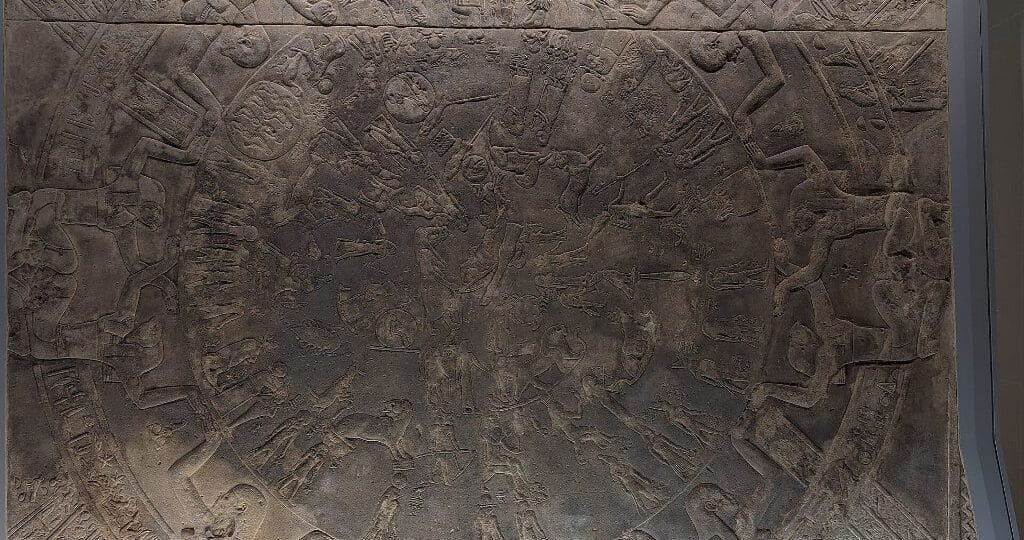
| Part of the disc | What it shows |
|---|---|
| The centre | The north pole star, with Ursa Minor as a jackal |
| The inner ring | The twelve zodiac signs |
| The outer ring | Thirty-six decans, each tied to about ten days of the year |
| The rim supports | Four women and four pairs of falcon-headed figures holding up the sky |
| The planets | The five planets known to the Egyptians |
| The square frame | A border aligned with the walls of the temple |
What Are the 36 Decans, and Why Did Egyptians Track Them?
Decans are thirty-six small groups of stars, each rising at dawn about every ten days. Thirty-six groups of ten days make 360 days, and five extra days complete the 365-day Egyptian year.
The system also worked as a night clock, because each decan’s rising marked a new hour of the night. Decan lists appear on coffin lids as early as the First Intermediate Period, so by the time the Dendera disc was carved the idea was already ancient. For a wider introduction, see Wikipedia’s overview of the Egyptian decans.
The sequence begins with Sirius, which the Egyptians called Sopdet. Its first appearance at dawn came around the start of the Nile flood and marked the new year. A sky map that starts with the star of the flood is a very Egyptian way of telling time.
Why Did the Decans Outlive Ancient Egypt?
The decans did not vanish when the pharaohs did. After Alexandria became a centre of Hellenistic astrology, each zodiac sign was given three decans, often called faces, and each face was linked to a planet.
That is why a system built to count nights on the Nile still appears in astrology books today. The Dendera disc sits at the moment of that handover, with the old Egyptian star groups and the new twelve-sign circle drawn side by side on one ceiling.
Seen this way, the zodiac at Dendera is less a mystery than a bridge. It shows how a practical calendar tool, invented to predict the flood and keep time after dark, slowly became part of a wider Mediterranean sky culture. Few monuments capture that transition as clearly.
Which Signs Look Egyptian and Which Look Imported?
Look closely and the disc speaks two visual languages. Aquarius appears as Hapi, the god of the Nile flood, pouring water from two vases, a distinctly Egyptian take on the sign.
Aries, Taurus, Scorpio and Capricorn, by contrast, appear in the same familiar forms used across the Greek and Roman world. Some scholars see Mesopotamian roots behind the twelve-sign circle itself, which is why the disc is often described as a blend of cultures rather than a purely Egyptian invention.
How Did Two Eclipses Help Date the Zodiac?
For generations scholars argued about the disc’s age, with guesses ranging from tens of thousands of years to a few centuries. The modern answer comes from the sky itself.
Researchers Cauville and Aubourg matched the planets’ positions and two eclipses shown on the disc: a lunar eclipse on 25 September 52 BCE, drawn as an Eye of Horus inside a circle, and a solar eclipse on 7 March 51 BCE, drawn as Isis holding the baboon Thoth by the tail. Together they point to about 50 BCE.
Eclipses mattered enough to be carved into a temple ceiling. If you would like to see one yourself, a total solar eclipse crosses southern Egypt on 2 August 2027, and our Egypt solar eclipse 2027 cruise puts you on the Nile for it.
How Can You Read the Disc in Five Minutes?
If you only have a few minutes in front of a photograph or the real ceiling, follow this short routine and you will understand most of what the carvers meant:
- Find the jackal near the centre, then remember that it marks the north pole of the sky.
- Look for Aquarius, the figure pouring water from two vases, and note how Egyptian it feels.
- Scan the outer ring and notice how many figures stand in a row, each one a decan.
- Pick out the animals and creatures you know from the Greek zodiac, such as the bull and the scorpion.
- Finish with the eclipse scenes, the Eye of Horus in a circle and Isis holding Thoth, which anchor the disc in real dates.
Doing this once makes every later visit to an Egyptian temple ceiling more rewarding, because you start to see maps where you once saw decoration.
What Should You Look For on a Visit to Dendera?
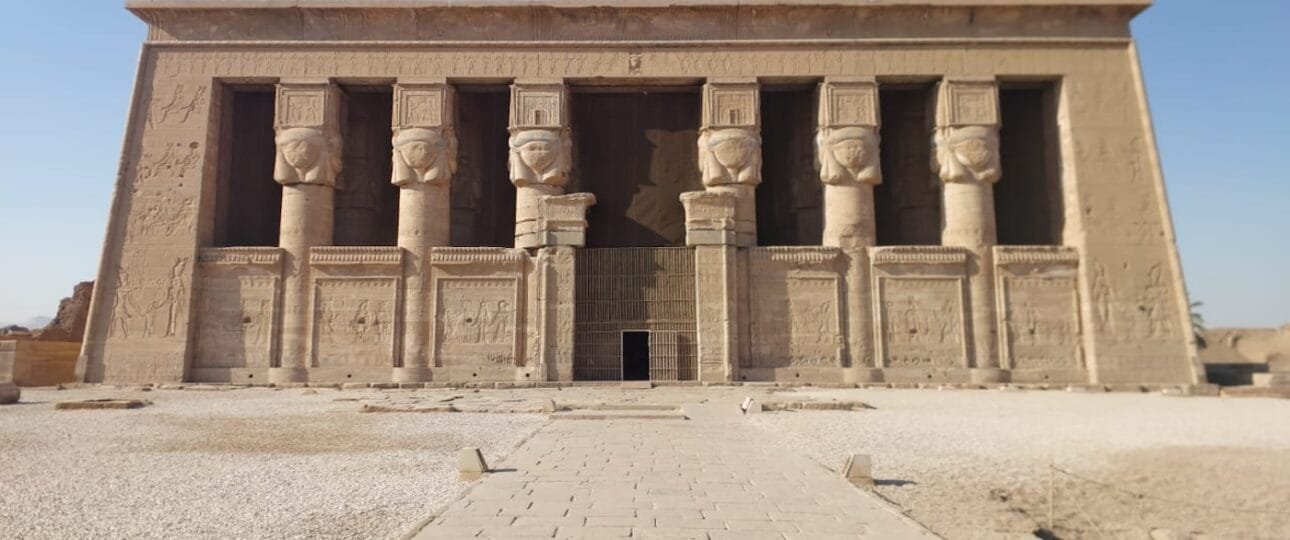
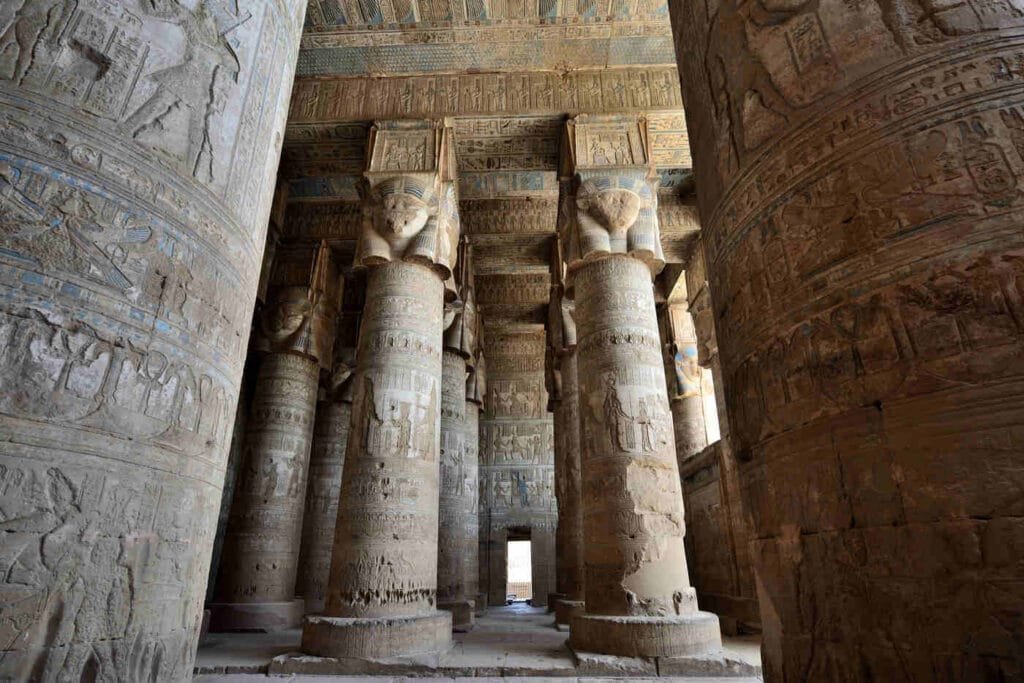
The round disc itself is in the Louvre, but the rectangular zodiac panels remain in the temple, so you can still see how the Egyptians drew the sky where it was meant to be seen. Start with the facade and its Hathor-headed columns, step into the great hall, then look up. The ceilings reward slow walking and a camera held high. Our guide to the Temple of Hathor at Dendera explains the rest of the complex.
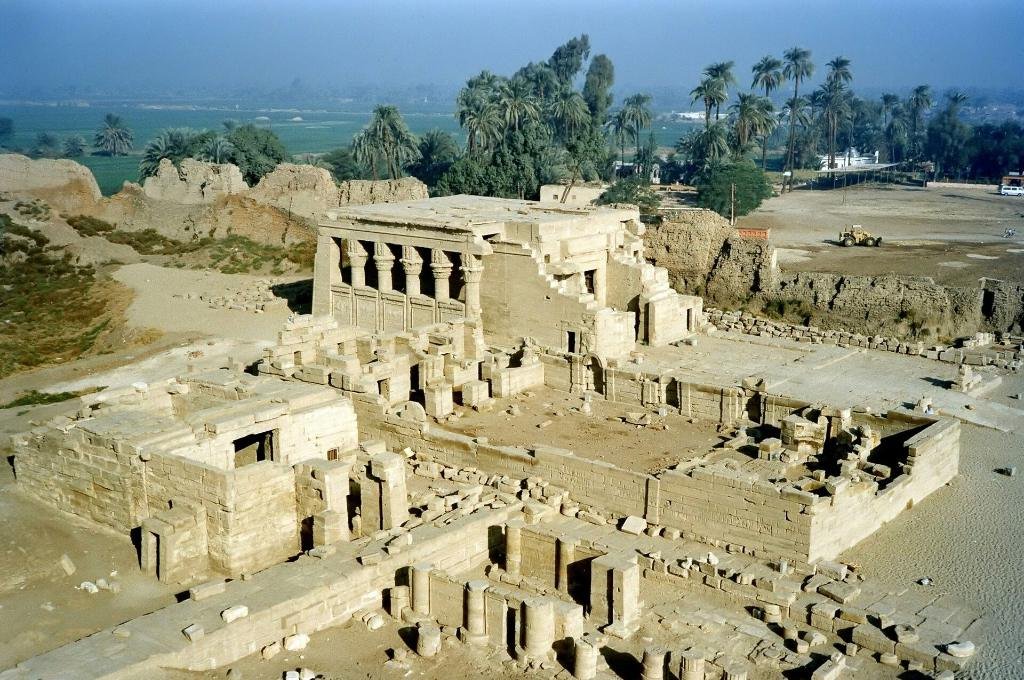
Dendera sits about an hour’s drive north of Luxor, so most visitors pair it with Abydos on a single day. Our Abydos and Dendera tour from Luxor handles the driving and the tickets, leaving you free to look up.
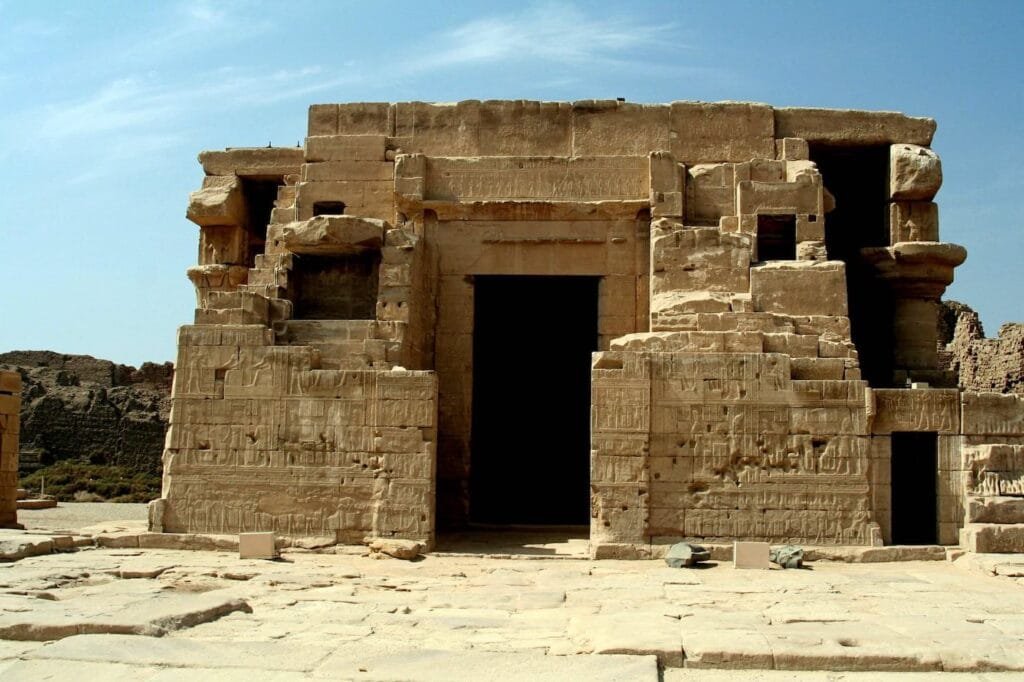
Prefer a ceiling that never left Egypt? Roman-era carvers also added zodiac signs to the hall at Esna. Our guide to the Esna temple shows where to look.
Questions Visitors Ask About the Dendera Sky Map
How many decans appear on the Dendera zodiac?
Thirty-six, arranged in the outer ring. Each one stands for a group of stars linked to roughly ten days of the Egyptian year.
Does the Dendera zodiac show the planets?
Yes. Five planets known to the Egyptians appear on the disc, and their positions are part of what lets researchers date it.
Why does Aquarius look like a god on the disc?
The Egyptians gave the sign a local face. Aquarius appears as Hapi, the god of the Nile flood, holding two vases that pour water, which suits a river valley built on the annual inundation.
Did the ancient Egyptians invent the zodiac?
Not the twelve-sign circle. Scholars trace its roots to Mesopotamian astronomy, and the Greeks later shaped it. What the Egyptians contributed earlier was the decan system, and the Dendera disc is where the two traditions meet.
Read the Sky, Then Walk Under It
Pick one ring of the disc, follow it from the centre outward, and the whole ceiling starts to make sense. When you are ready to stand under the real thing at Dendera, our team is happy to help you plan the day around your Luxor dates. Bring a zoom lens or binoculars if you have them, since the best details sit high overhead, and give yourself ten unhurried minutes before the group moves on.
